
Hands
8 parts with data · 58 more listed by name. Columns, units and filters follow this category's display rules. Rows run from small to large. Each cell links through the part page to its source. m marks an independent measurement. How it works
Pick a type


 Direct drive (5)
| Pick to compare | Maker | Model | Degrees of freedom | Actuators | Payloadkg | Control rateHz | Massg | Price, 1 pcUSD |
|---|---|---|---|---|---|---|---|---|
| Unitree | Dex3-1Dex3-1 | 7 joints | 0.5 | 710 | ||||
| Unitree | Dex5-1Dex5-1 | 20 joints | 1,100 | |||||
| Unitree | Dex5-SDex5-S | 22 | 1 | 620 | ||||
| Unitree | Dex5-S ProDex5-S Pro | 22 | 1 | 620 | ||||
| Unitree | Dex5-1PDex5-1P | 1,100 |
 Tendon driven (3) price $3,500.00 to $6,100.00, median $4,800.00
| Pick to compare | Maker | Model | Degrees of freedom | Actuators | Payloadkg | Control rateHz | Massg | Price, 1 pcUSD |
|---|---|---|---|---|---|---|---|---|
| ORCA | orcahand v2.1 baseorcahand v2.1 base | 17 | $3,500.00 | |||||
| ORCA | orcahand v2.1 touchorcahand v2.1 touch | 17 | $6,100.00 |
Listed without specifications (1)
These parts have no value in the columns above. Their part pages hold any other values and the prices.
| Pick to compare | Maker | Model | Price, 1 pcUSD |
|---|---|---|---|
| TetherIA | Aero Hand OpenAero Hand Open |
How it works
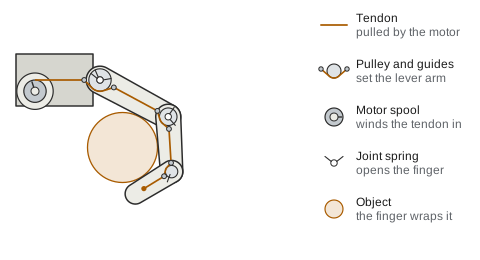
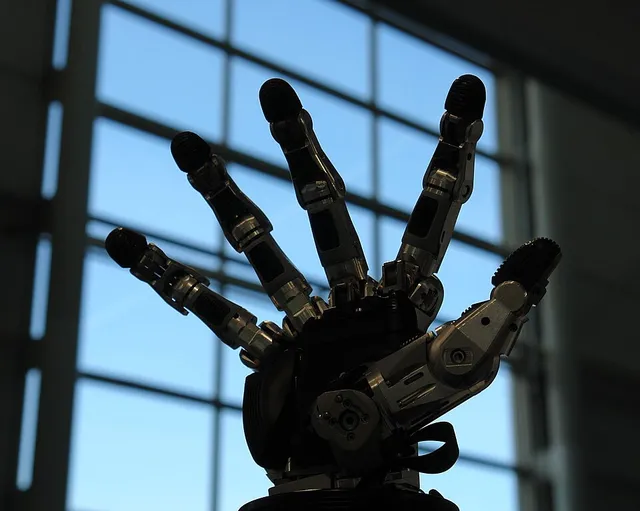
Photo: NearEMPTiness, CC BY-SA 4.0. source · credits

Types and how they differ
Tendon-driven dexterous hand: Motors sit in the palm or forearm and pull tendons to bend finger joints; the hand stays light and compliant.
Variations: Shadow Dexterous Hand family, 20 motors and 24 joints; ORCA hand, 17 DoF, open-source build files; Aero Hand Open, 7 DoF, open design
For: Light fingers; Shock mitigation from the tendon elasticity; Many joints with few moving masses at the finger
Against: Tendon wear and re-stringing (ORCA rates 200,000 cycles); Tendon stretch makes joint angles less certain without sensing
Sources: 1
Direct-drive or geared in-finger actuator hand: Micro brushless or servo actuators sit in the finger joints and drive them directly or through a short gear.
Variations: Unitree Dex3-1: 6 direct-drive joints plus 1 geared; Tesollo DG-5F: one actuator per joint; Wonik Allegro Hand family, 16-DOF versions
For: Fast torque control at the joint; Joint state read at the joint without a tendon model
Against: Heavier fingers; Higher cost and mass at the palm and fingers
Sources: 1